Watch a child at a drawing table or a keyboard, and you often see total focus. Time seems to disappear. Music and art for children are often treated as extras, fitted in after the “real” subjects. In our experience, they do far more than fill a timetable. They help children think, settle and learn better in every class, which is why creative time has a fixed place at MauryanHigh.
Why do music and art matter so much?
Music and art help children build focus, patience and confidence. These skills carry straight into maths, science and language lessons.
A child learning a song practises memory and timing. A child finishing a painting learns to plan, make mistakes and try again. Neither feels like hard work, yet both build habits that every teacher values. Creative subjects also give quieter children a way to shine, which changes how they feel about school.
Myth vs fact
Myth: Some children are “right-brained” and creative, while others are “left-brained” and logical.
Fact: Both halves of the brain work together on almost every task. Creative activities simply engage many areas of the brain at once, which is part of their value.
How do music and art for children help the brain?
Creative activities ask the brain to do several things together, such as listening, moving, remembering and imagining. This kind of practice supports attention and problem-solving in other subjects.
To play a rhythm involves counting the beats, a practice that is closely related to early mathematics. When children learn by observing, they develop the ability to notice details, a skill which is useful in the study of science. Drama and dance help to improve memory since students memorise lines and sequences.
Here is how each activity helps in class:
Activity | Skills it builds | How it helps in class |
Music | Listening, memory and timing | Stronger recall and pattern spotting in maths |
Art | Observation, planning and patience | Neater diagrams and closer attention to detail |
Dance | Coordination and sequencing | Better focus and following steps in order |
Drama | Speaking and understanding emotions | Confident presentations and reading with expression |
How do creative activities support a child’s wellbeing?
Music and art give children a calm, safe way to express feelings. They can help children relax after a busy day and manage everyday stress.
It isn’t possible for all children to put their worries into words; some express them by drawing and others by singing. When pupils engage in a short amount of creative activity, the atmosphere in the whole class changes. Teachers frequently observe students coming back to lessons in a calmer state and more willing to listen. Eventually, completing an artwork or performing in front of an audience also leads to genuine confidence.
What does creative life look like at MauryanHigh?
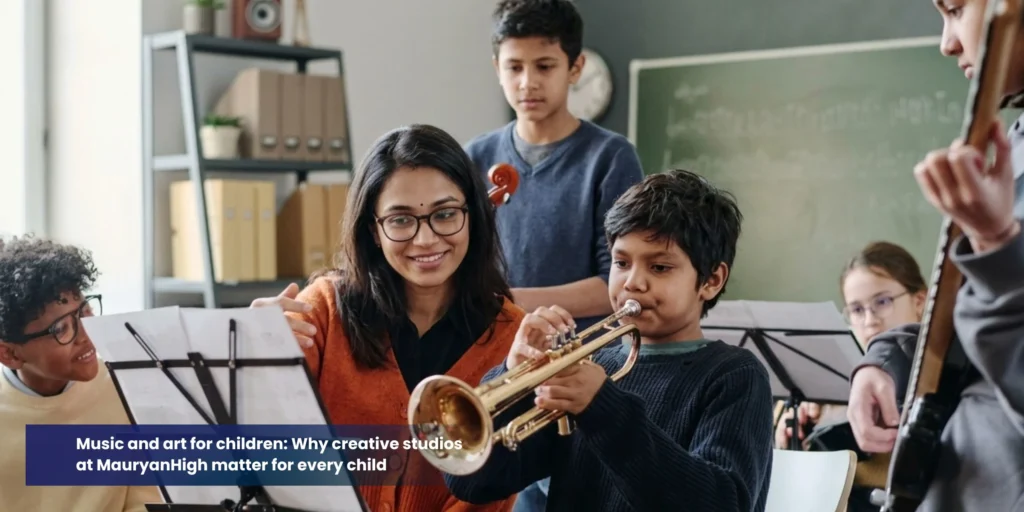
At MauryanHigh, students work in dedicated music and art studios rather than a spare corner of a classroom. That space matters, because it tells children their creative work is valued.
Students take part in music, dance, art and drama throughout the year. Younger children enjoy classroom crafts and creative projects, while festivals and rangoli competitions bring the whole school together. Our curriculum includes STEAM learning, where the A stands for arts, and you can read more in our post on STEAM education and future ready learning.
From the 2027 to 28 session, students will also take part in cultural fests across the Bellwether school network. With classes limited to 30 students, every child gets a turn to create and perform. This builds a warm classroom learning environment where creativity is encouraged.
Did you know? CBSE asks schools to include art-integrated projects for Classes 1 to 10, using art forms to teach other subjects.
How can parents encourage creativity at home?
Creativity grows with small, regular chances to play. Try these ideas:
- Keep paper, colours and simple craft supplies within easy reach.
- Play different kinds of music during car rides or meals.
- Praise effort and ideas, not just neat results.
- Let children sing, dance or act out stories without correcting them.
Our guide to extracurricular activities in CBSE schools shares more ideas for a balanced school life.
See our creative studios in action.
Many parents searching for the best school in Vadodara focus only on marks and facilities. Music and art for children deserve a place on that checklist too. As an English medium school in Vadodara, we give creative time the same care as any core subject.
We invite you to visit MauryanHigh at Sigma Campus, Ajwa Nimeta Road, Vadodara 390019, and see our music and art studios in use. Our office is open from 8 am to 5 pm, Monday to Saturday. Call 9099995360 or 02668 267155, or email admissions@mauryanhigh.ac.in to plan your visit.
FAQs
1. What are the benefits of music and art for children?
Music and art help to develop a sense of focus, memory, patience and confidence. They also enable children to relax and express their feelings, and these abilities transfer into lessons in maths, science and language, thus contributing to more effective learning in general.
2. Are some children right-brained and others left-brained?
No. This is a popular myth. Both halves of the brain work together on almost every task. Creative activities are valuable because they engage many brain areas at once, not one side.
3. How does music help a child’s brain?
Music asks children to listen, count beats, remember patterns and coordinate movement together. This practice supports attention, memory and pattern spotting, which also help in subjects like maths and reading.
4. Does CBSE include art in the curriculum?
Yes. CBSE asks schools to include art-integrated projects for Classes 1 to 10, where art forms such as music, painting or drama are used to teach other subjects in a more engaging way.
5. Does MauryanHigh have music and art facilities?
Yes. MauryanHigh has dedicated music and art studios on campus. Students take part in music, dance, art and drama throughout the year, along with crafts, festivals and rangoli competitions.