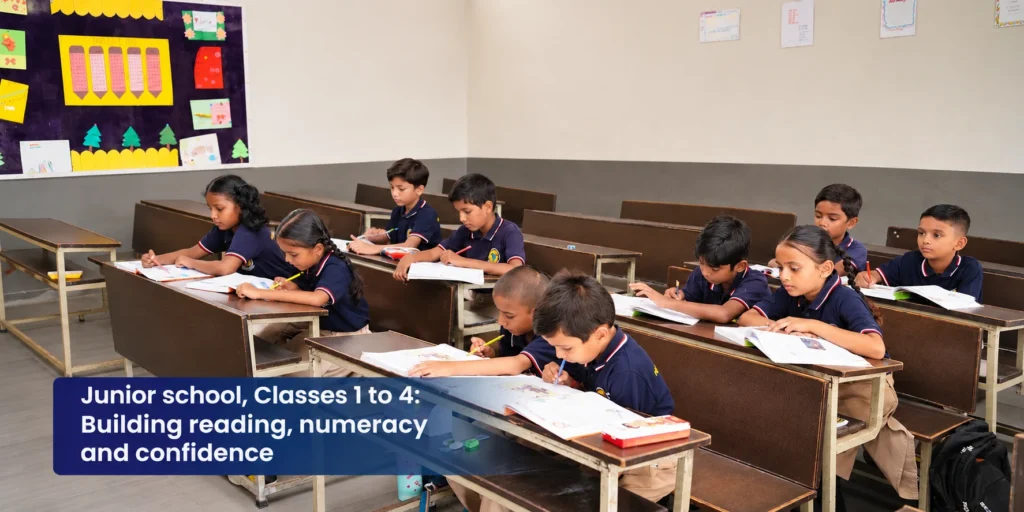
A six-year-old who manages to read a whole sentence by himself usually feels a great deal of pride, and this small moment is more significant than it appears. The junior school years are the time when children develop their reading, numeracy, and self-confidence, all of which are essential for every subject that comes later. At Mauryan High we consider Classes 1 to 4 to be the foundation of a child’s entire school experience and take real care in planning these years.
Why does junior school matter so much?
The basic skills that children develop in junior school are used in all the subjects that come after it, and a child who is good at reading and likes numbers will find Classes 5 to 10 much easier.
Both science questions and maths word problems assume that a child is able to read with understanding; whenever these skills are weak, the gap between what the child can do and what is expected widens a bit each year. From our experience, consistent support in Classes 1 to 4 stops most of the difficulties that parents end up worrying about.
Did you know?NIPUN Bharat initiative, which the Ministry of Education launched in 2021, seeks to have every child be able to read with understanding and carry out basic maths by the end of Class 3, with the target period being 2026 to 2027.
How do we build reading in junior school?
We build reading through curiosity, stories and plenty of speaking and listening. Children who enjoy books read more, and children who read more read better.
Our lessons are hands-on and interactive. Teachers guide children to explore ideas themselves rather than repeat answers. Reading aloud, talking about a story and asking “what happens next?” all help a child understand, not just decode words. Our library gives young readers a quiet space to choose books that interest them.
As an English medium school in Vadodara, we also help children grow comfortable speaking and writing in English from the early years.
How do we build numeracy?
We make maths practical and connected to everyday life. Counting and measuring become part of real tasks that children recognise.
A child who shares a packet of biscuits out among their friends is in the process of learning about division. Such situations allow us to make numbers seem useful rather than intimidating. The lessons also promote critical thinking, since children are asked to explain how they arrived at an answer rather than simply writing down the answer.
How do we build confidence?
Confidence grows when children feel safe to speak, try and make mistakes. A warm classroom learning environment makes that possible.
We keep every class to a maximum of 30 students, so our qualified teachers can attend to each child’s learning needs. Group activities teach children to share, take turns and work with others. Values-based lessons also build kindness and respect, which helps children form healthy friendships.
Here is how these early skills pay off later:
Skill | What it looks like in Classes 1 to 4 | How it helps later |
Reading | Reading stories aloud and talking about them | Understanding textbooks in every subject |
Numeracy | Using numbers in everyday tasks | Handling maths and science with ease |
Confidence | Speaking up in class and asking questions | Presenting ideas and taking on leadership roles |
Teamwork | Sharing and working in small groups | Group projects and healthy friendships |
How can parents help at home?
Little daily habits within the home can make a great difference. Here are some simple suggestions:
- Read together for 15 minutes before bed.
- Get your child to count, weigh or measure as you are cooking.
- Let each of them describe their school day in their own words.
- Praise effort. Do not focus only on correct answers.
- On school nights, it is important to limit the amount of time spent on the screen.
Consistency matters more than long sessions. A few calm minutes every day help far more than one long session on the weekend.
What comes after junior school?
After Class 4, children move into our middle school for Classes 5 to 8. With strong reading, numeracy and confidence in place, they are ready for more independent learning, projects and new subjects.
You can learn more about this stage on our junior school page, and read about our wider approach to early education.
Give your child a strong start at Mauryan High
Many parents searching for the best school in Vadodara compare buildings and fees first. Yet the early years decide how much a child enjoys learning. Among CBSE schools in Vadodara, we aim to make junior school a place where children grow curious and confident.
We would like to invite those children who are entering Classes 1 to 4 in the 2027–28 academic year to come and see Mauryan High at its Sigma Campus on Ajwa Nimeta Road, Vadodara 390019. Our office is open from 8 a.m. to 5 p.m. from Monday through Saturday. Please call either 9099995360 or 02668 267155, or send an email to admissions@mauryanhigh.ac.in if you would like to arrange a visit.
FAQs
1. Which classes are part of junior school at Mauryan High?
Junior school at Mauryan High covers Classes 1 to 4. Children build reading, numeracy and confidence through hands-on lessons, group activities and values-based learning in classes of no more than 30.
2. How can I find good junior schools near me in Vadodara?
Shortlist CBSE schools that publish clear admission criteria, then visit each one. Look for small classes, hands-on lessons and teachers who know every child. Mauryan High welcomes visits at its Ajwa Nimeta Road campus.
3. How does Mauryan High build reading skills in young children?
We build reading through stories, reading aloud and discussions about what children read. Teachers guide children to explore ideas themselves, and the school library gives young readers a quiet space to choose books.
4. How can parents help build numeracy at home?
Introduce numbers into everyday activities by asking your child to count, weigh or measure when cooking, or by dividing snacks equally among the family members. Doing these short and regular exercises makes mathematics seem more useful and much less frightening.
5. What is the admission process for Class 1 at Mauryan High?
Admission to Class 1 is on a first-come, first-served basis and involves document verification as well as a meeting with the Principal; both parents have to attend this meeting, and the places are dependent on availability for 2027 to 28.